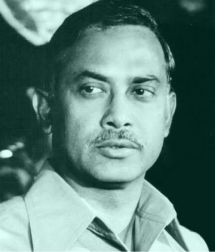
Founder of BNP & President (1936–1981)
Lieutenant General Ziaur Rahman Bir Uttam (1936–1981) was the proclaimer of independence and the elected President of Bangladesh. He was a valiant freedom fighter, Chief of Army Staff, and the founder of multi-party democracy in Bangladesh, as well as the founder of Bangladeshi nationalism and the Bangladesh Nationalist Party (BNP).
Early Life
Ziaur Rahman, fondly called Zia, was born on 19 January 1936 at Bagbari in Bogra. His father, Mansur Rahman, was a chemist who worked in a government department in Calcutta. He spent his childhood partly in the rural areas of Bogra and partly in Calcutta. After the partition of India in 1947, when his father was transferred to Karachi, Zia had to leave the Hare School in Calcutta and become a student of the Academy School in Karachi. He completed his secondary education there in 1952. In 1953 he was admitted to the D.J. College in Karachi, and in the same year he joined the Pakistan Military Academy at Kakul as an officer cadet.
Life in the Army
Ziaur Rahman was commissioned as a second lieutenant in 1955. He served for two years and in 1957 was transferred to the East Bengal Regiment. He also worked in the military intelligence department from 1959 to 1964. In the Indo-Pakistan War of 1965, Zia fought in the Khemkaran sector as a company commander; notably, his company received the largest number of gallantry awards for its heroic performance. In 1966 he was appointed an instructor at the Pakistan Military Academy. In 1969 he joined the Second East Bengal Regiment at Joydevpur as its second-in-command and received higher training in West Germany. On his return home in 1970, Zia, then a major, was transferred to the Eighth East Bengal Regiment at Chittagong as its second-in-command.
Heroism in the Liberation War
At midnight on 25 March 1971, the Pakistani military started firing indiscriminately on the unarmed, sleeping people of the then East Pakistan and carried out one of the worst genocides in history, known as "Operation Searchlight".
Major Ziaur Rahman rebelled against Pakistan on 25 March 1971. Then, on 26 March, with the help of the radio-station workers, he proclaimed the declaration of independence from the Kalurghat radio station in Chittagong, saying: "I, Major Zia, Provisional Commander-in-Chief of the Bangladesh Liberation Army, hereby declare the independence of Bangladesh."
Zia first became the commander of Sector 1 and, from mid-July, the Brigade Commander of the Z Force during the war of independence. On 28 August 1971 he established the first civil administration at Rowmari, an area freed from the Pakistani invaders within the geographical boundary of Bangladesh. For his heroic contribution to the liberation war, Ziaur Rahman was decorated with 'Bir Uttam', the second-highest gallantry award of Bangladesh.
Inevitable Rise in Bangladesh Politics
After his most creditable performance in the nine-month war, Zia was appointed Brigade Commander in Comilla. In June 1972 he became Deputy Chief of Staff of the armed forces of Bangladesh. By mid-1973 he was a Brigadier, and by the end of the year a Major General. Ziaur Rahman became Chief of Army Staff on 25 August 1975. During the coup of 3 November 1975 he was forced to resign his command and was placed under house arrest. The Sepoy-Janata Revolution of 7 November, however, brought him to the centre of political power.
On 7 November 1975, Ziaur Rahman was reassigned as the Chief of Army Staff. He became the Chief Martial Law Administrator on 19 November 1976 and, when President Sayem resigned on 21 April 1977, he became the President of Bangladesh.